


Most of the concrete we cut in a given week comes apart with a disc. A floor saw takes up slabs, a track saw takes down walls and beams, and between them they cover the majority of what a site needs. Every so often, though, a section turns up that is beyond the reach of any blade — a transfer slab, a deep pile cap, a heavily reinforced basement wall. That is where diamond wire sawing stops being one option among several and becomes the only sensible one.
The photographs below are from Ralkore wire sawing work. They show the rig in position, the cut itself, the face it leaves behind, and a section being lifted out.
How a wire saw actually cuts
A diamond wire saw wraps a diamond-beaded wire around the section to be removed. The wire passes through a series of pulleys, is tensioned, and is then drawn continuously through the concrete. Because the cutting element is a loop rather than a disc, there is no blade radius to run out of. The depth the saw can reach is set by the geometry of the section and the access around it, not by the size of the machine.
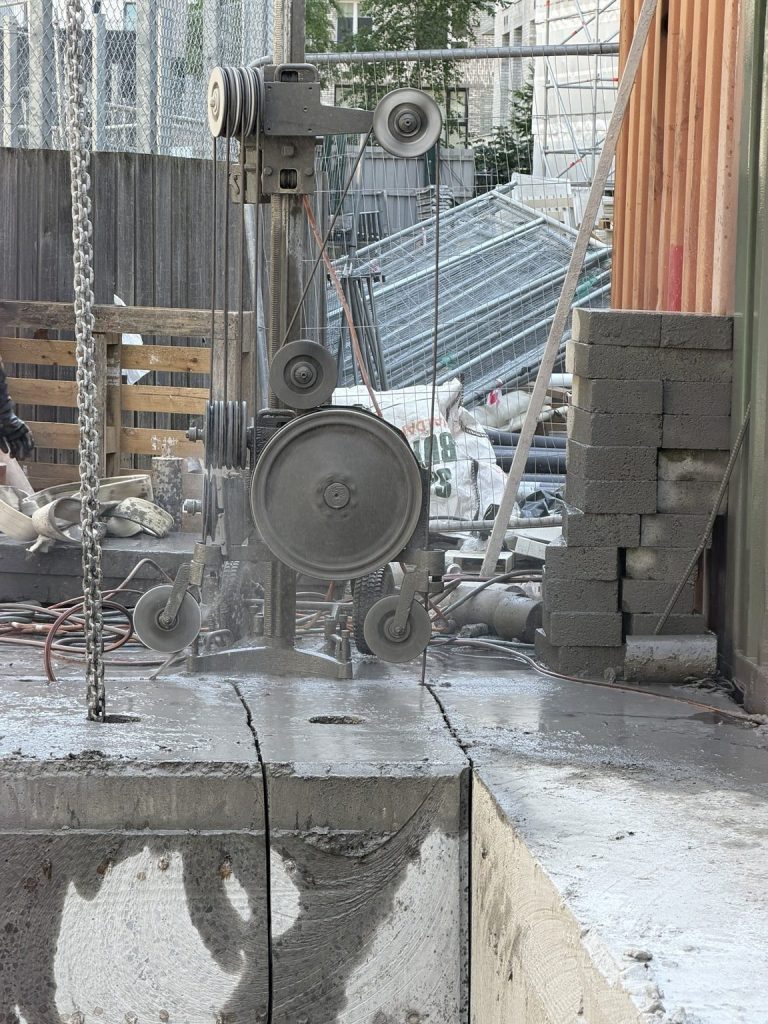
That one difference is what makes wire sawing the right call in a small number of specific situations. It is worth being equally clear that on most jobs it is not the right call: a track saw or a floor saw will be quicker and cheaper, and we will say so. The cases below are the ones where the wire earns its place.
When the section is simply too thick
Blade depth is the first and most obvious limit. Our track saws cut reinforced concrete walls and floors to a depth of up to 1000mm, and our floor saws reach up to 500mm. Those figures cover a great deal of work. Once a section passes them — and thick transfer structures, mass concrete bases and heavy substructures routinely do — a disc has nowhere left to go.
A wire saw has no equivalent ceiling. Sections well over 600mm are ordinary work for it, and the practical constraint becomes whether the wire can be routed around the concrete, not how deep the cut needs to be.
When the concrete is heavily reinforced
Diamond wire cuts steel and concrete in the same pass. Heavy reinforcement, couplers, starter bars and cast-in steel do not stop the cut or force a change of method; they simply slow it down. The face is left flat and the bar ends are severed in line with it.

That matters after the cut as much as during it. A straight face with the steel cut flush usually means very little making good — no over-break to patch, no ragged edge to form up against.
When access and space are restricted

The drive unit does not have to sit at the cut. It can be set back and the wire routed to the concrete, which makes wire sawing workable in places where a large saw could not physically be positioned: over a propped opening, inside a basement, alongside live plant, or hard against a boundary.
When vibration has to stay low
Wire sawing is a continuous abrasive cut, not an impact process. Compared with breaking, it puts very little vibration into the surrounding structure. On occupied buildings, on refurbishment work next to finished areas, and anywhere the element being cut is also holding something else up, that is frequently the deciding factor rather than a nice-to-have.
When the section has to come out in one piece
The cut is only half the job. Sections of this size have to leave the site somehow, and breaking them up in place is often the worst way to do it — noise, dust, debris, and load paths nobody planned for.
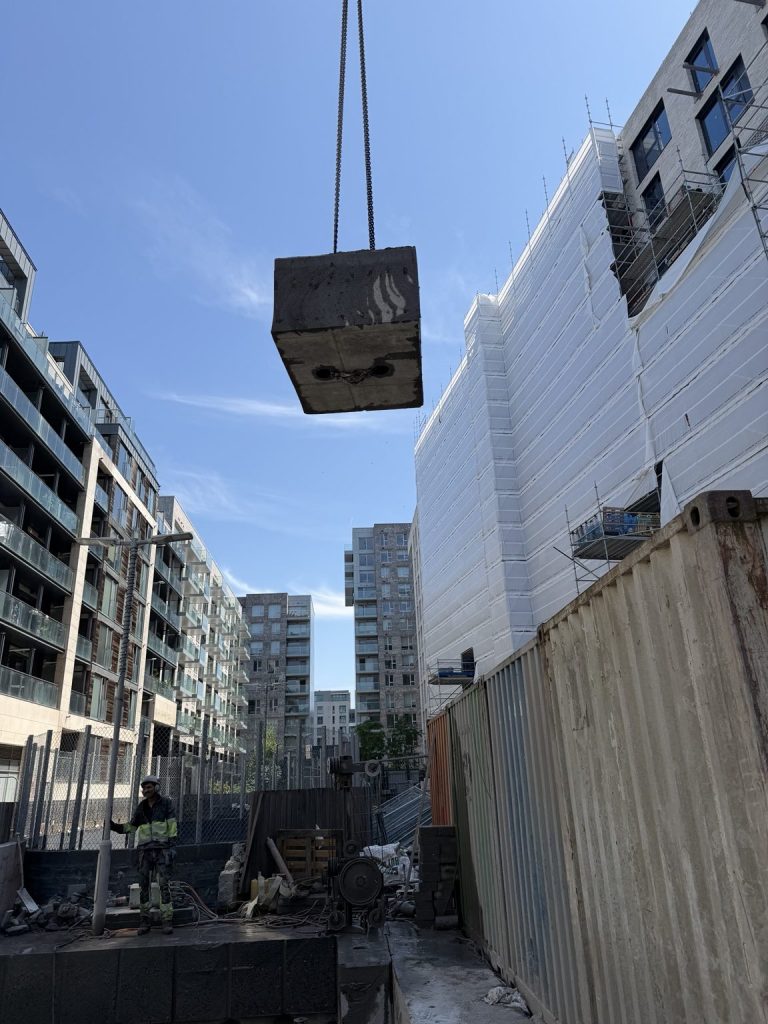
Wire sawing allows the concrete to be divided into defined blocks and lifted out under control, with lifting points cored through them in advance. That is a planning decision as much as a cutting one, and it is worth putting on the table early, while crane time and access are still being arranged.
When to specify diamond wire sawing
In short, wire sawing is the method to ask for when:
- the section is thicker than a disc can reach, including over 600mm
- the concrete is mass concrete or heavily reinforced
- the saw cannot be positioned at the cut line because of access
- vibration into the surrounding structure has to be kept low
- the cut has to be accurate and the finished face clean
- large sections need to come out whole, under control
If none of those apply, a track saw or a floor saw is very likely the better answer, and it will cost less.
Talk to us about the cut
If you have a section and you are not sure how to take it out, send us the details: thickness, reinforcement, access, and what is around it. We will tell you whether it is a wire sawing job or whether something simpler will do.
See our diamond wire sawing service, or get in touch with the drawings and we will come back to you.